
P.I.
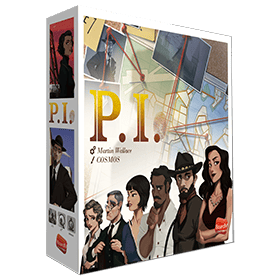 P.I.是一款纯粹的逻辑推理游戏,玩家通过连续三局迷你游戏比拼谁最有破案的本事。
每局迷你游戏的玩法相同。开始时,你会秘密收到一张嫌犯牌(共12张)、一张罪行牌(共10张)和一张地点牌(共14张);这组信息代表你左手边的玩家需要破解的案件。版图上有14个地点,每个地点与若干其他地点相邻;每个地点都有一个放置嫌犯和罪行板块的位置。洗混嫌犯板块(12张,外加两张"无线索")和罪行板块(10张,外加四张"无线索"),然后在每个地点面朝上放置一个。每名嫌犯、罪行和地点都包含在一副证物牌中,并翻开九张证物牌。
轮到玩家时,可以派遣一名探员、选择一张证物牌,或尝试破案。当你在某个地点派遣探员时,你右手边的玩家查看他手中的案件牌,然后对每张与当前地点的嫌犯、罪行或地点匹配的案件牌,在该位置放置一个圆盘。此外,他对每个与当前地点相邻的嫌犯、罪行或地点,在该位置放置一个方块。
当你选择一张证物牌时,若该牌与你右手边玩家手中的某张案件牌匹配,他在匹配的板块上放置一个圆盘;若该板块与他手中的某张案件牌相邻,则在相邻板块上放置一个方块;若你凭空猜测且该板块与任何内容都不相邻,则什么都不放。
尝试破案时,你在所选要素上放置一个黑色标记。若选错,扣2分并在下一回合继续游戏。若选对,根据此前已有多少位玩家破案,获得7、5、3或1分。
所有玩家都破案或仅剩一人未破案时,该局迷你游戏结束。所有已使用的探员从游戏中移除,然后重置版图和牌堆进入下一局。每位玩家总共只有五名探员,请好好利用!
三局游戏结束后总分最高者获胜。
玩家人数: 2 - 5
游戏时长: 19 mn
复杂度: 2 / 5
在线上玩 P.I. 以及 1414 款其他游戏。
无需下载——直接在浏览器上玩.
与您的朋友以及来自世界各地的玩家一起.
免费。


在线上玩 P.I. 以及 1414 款其他游戏。
无需下载——直接在浏览器上玩.
与您的朋友以及来自世界各地的玩家一起.
免费。
玩法简介
Overview
- P.I. (Private Investigator) is a simple deductive game consisting of 3 mini-games.
Objective
- Each player has three cases that they need to solve.
- You win by getting the most points for solving the three cases.
- To solve a case you need to show the following elements: the criminal, the location of the crime and the type of crime.
- Each player solves their own unique case each in round.
- The player on your right has your Case Cards, which show the elements of the case you are solving.
Second Edition Changes
BoardM Factory's Second Edition updates P.I. with new artwork throughout, several terminology changes, a reworked scoring system, and a dedicated two-player Duel mode. The underlying rules of deducing your case across mini-games by placing investigators, collecting clues, and comparing them to the board are unchanged. This section covers what's different.
Terminology
Several things were renamed for clarity. They play the same role as before, just under a new name.
| First Edition | Second Edition |
|---|---|
| Evidence (the 36-card deck you draw/collect) | Clues |
| Crime (one of the three case categories) | Evidence |
| Cubes (indicates the current tile is adjacent to the correct tile) | Trace markers (circular) |
| Discs (indicates the current tile is the correct tile) | Spot markers (rectangular) |
Several location names and some suspect names have also changed. The set of items, suspects, and locations themselves is different from First Edition, but the number of each and how they function is the same.
Rounds and Scoring
Mini-games are now called rounds.
Each round has its own fixed point schedule based on solve order within that round:
| Round | 1st solver | 2nd | 3rd | 4th |
|---|---|---|---|---|
| 1 | 7 | 5 | 3 | 1 |
| 2 | 8 | 6 | 4 | 2 |
| 3 | 9 | 7 | 5 | 3 |
An incorrect solve attempt still costs the player 2 points.
Each player has a single score marker on a shared track, ranging from -5 to 21. Points are tracked cumulatively and live.
Any attempt at solving, right or wrong, flips your score marker over on the track. Once every player has flipped their marker (or all but one have), the round ends as soon as play comes back around to the first player.
Duel Mode (2-player only)
Duel mode is a separate, faster variant with its own win conditions. It's played on the board's night side. Each player starts with 2 investigators and gains 2 more at the start of each following round, up to a maximum of 5 held at once.
Each round has a single winner, at mose, who gains 1 point:
- If the first player to attempt solving their case is correct:
- If they have the first player marker, their opponent has one more chance to solve their case.
- If their opponent also correctly solves their case, the round ends in a tie. Otherwise, the first player wins.
- If they do not have the first player marker, they win immediately.
- If they have the first player marker, their opponent has one more chance to solve their case.
- If the first player to attempt solving their case is incorrect, their opponent wins the round.
After each round, the winner places one of their new investigators on the round winner space (which reduces their available investigators for the next round). For tied rounds, no investigator is placed on the round winner space. The game ends when one player has won 2 rounds.
Actions
Each turn you choose only one of the following actions:
- 1) Use an investigator on a location (you only have 5 for the entire game)
- 2) Pick an evidence card
- 3) Attempt to solve the case
Using an Investigator
- Each Location Card consists of a criminal tile, a location tile, and a crime tile.
- Using an Investigator on a Location Card tells you the number of tiles matching your Case Cards elements (the criminal and/or the location and/or the crime) in or near that location, as well as the number of elements.
- Discs and cubes are placed by the Investigator as follows:
- •Disc: An element is in this Investigator's location.
- •Cube: An element is in a location that is adjacent to this Investigator's location. It does not tell you what that element is.
- Note: You only have 5 Investigators and they are 'one use' only for all three rounds of the entire game.
| # Case cards matching in the Investigator's location | The result represented in
Discs & cubes |
# Case cards matching in a location adjacent to the Investigator | |
|---|---|---|---|
| 3 | 3 discs | 0 cubes | 0 |
| 2 | 2 discs | 1 cube | 1 |
| 1 | 1 disc | 2 cubes | 2 |
| 0 | 0 discs | 3 cubes | 3 |
| 2 | 2 discs | 0 cubes | 0 |
| 1 | 1 disc | 1 cube | 1 |
| 1 | 1 disc | 0 cubes | 0 |
| 0 | 0 discs | 0 cubes | 0 |
Using Evidence Cards
- Using an Evidence Card allows you to investigate one particular element of your case.
- It will only tell you the matching tiles that are the same type as the selected Evidence Card.
- •Disc: If the Evidence Card matches one of your Case Cards, a disc is placed on the matching tile.
- •Cube: If the Case Card's tile is in an adjacent location to the Evidence Card's tile, then a cube will be placed on the tile.
Additional Rules With Using Evidence Cards
- If you already have a disc/cube on one of your Investigator Counters and it corresponds with the selected Evidence Card then the disc/cube is moved from the Investigator Counter to the tile matching the selected Evidence Card.
- If a disc/cube is placed then it must be placed on the tile.
- If no disc/cube is placed then you place the Evidence Card in front of your position to remind you that no information was gained.
- If you do place a disc/cube then you discard the Evidence Card.
Attempt to Solve the Case
- Finally you can attempt to solve the case, click on a criminal, a location and a crime type.
- If you're right, then you get points according to how many players solve their cases before you. (7 for first, 5 for second, 3 for third and 1 for fourth.)
- If you're wrong, then you lose 2 points. Next turn you can try again, but you accrue the VP penalties (and lose time).
- If everyone has solved but you, you get 0 points (and penalties you have accrued).
Phases
- The game consists of 3 rounds, players are attempting to solve one case in every round.
- Each round is composed of phases where each player takes a turn playing one action.
- Beginning with the starting player.
Solving a case
- Once a player solves a case for the first time in that round, (in phase 6 of the current round for example,) they get 7 points, and each subsequent player who solves their case in the same phase (phase 6 in our example) also gets 7 points.
- Once the phase ends, if there are at least two players who didn't solve the case yet, then the game continues, but on the phase the next player solves the case, they get 2 fewer points--and that goes for all players who solve the case in that same phase.
- This continues on and on, until only 1 (or 0) player remains.
- If one player remains at the end of a phase, that player won't gain any points for the round, and the next round starts.
Tiebreakers
- In the case of a tie, the winner is the tied player who has the:
- Most Investigator pieces.
- Fewest penalty points.