
名侦大赛
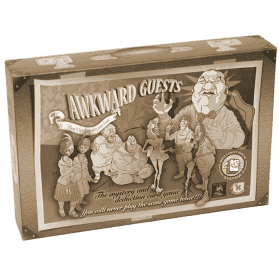 《Awkward Guests》是一款独一无二、拥有无限重玩价值的推理游戏。你可以用如此多种不同的方式重现沃尔顿先生遇害案,绝不会遇到两局相似的游戏!(沃尔顿先生不会因此感谢你。)
这款游戏将考验你运用真正的侦探能力来破解每一桩案件。要解开谜团,你必须审问嫌疑人、询问管家仆人、勘察犯罪现场、在沃尔顿庄园内搜寻线索,并查阅警方报告。在进行这些调查的同时,你需要与对手交换信息或向他们隐瞒信息,所以请准备好施展你所有的侦探本领吧!
谁杀害了沃尔顿先生?
凶手是如何结束他的生命的?
凶手为什么要杀他?
是否有同谋?
《Awkward Guests》的核心机制很简单:玩家手持6张卡牌,每张卡牌都有1个点数(根据其提供的信息量,分别为 1、2 或 3 分)和多个参考对象(即卡牌信息所涉及的主题)。在回合中,你可以询问2个你感兴趣的不同参考对象的相关信息。 其他玩家可以向你提供包含所请求对象的卡牌,而你可以通过从手牌中支付与对方出示的分数相等的点数,来换取这些卡牌。
每轮结束后,玩家可以尝试解开谜题。如果谜题未被解开,玩家需弃掉部分手牌,并抽取3张新卡牌。最先解开谜题的玩家获胜。
玩家人数: 1 - 8
游戏时长: 18 mn
复杂度: 2 / 5
在线上玩 名侦大赛 以及 1378 款其他游戏。
无需下载——直接在浏览器上玩.
与您的朋友以及来自世界各地的玩家一起.
免费。


在线上玩 名侦大赛 以及 1378 款其他游戏。
无需下载——直接在浏览器上玩.
与您的朋友以及来自世界各地的玩家一起.
免费。
玩法简介
Awkward Guests: The Walton Case
This is a deduction and information-trading game. All players try to solve the murder on Mr. Walton. The first player to do so correctly, wins the game.
Each player has their own investigation sheet (private to them) to keep track of the information they learn during the game.
Goal
Be the first player to correctly solve the case by identifying:
- - WHO killed Mr. Walton?
- - WHY did they kill him (motive)?
- - HOW did they put an end to his life (weapon)?
- - Was there an ACCOMPLICE and, if so, WHO and WHY?
(For Beginner / Very Easy / Easy cases there is never an accomplice.)
Information in the game
Each card has:
- - an information value (1–3), representing the amount of valuable information, and used to price exchanges;
- - references (suspects and/or rooms) showing what the info is about;
- - the case-related information;
- - how the information can be denoted on the tracking sheet.
Round structure
The game is played in rounds. In each round, every player takes one turn (anti-clockwise). Each turn has 3 phases:
- - Inquiry Phase
- - Offer Phase
- - Exchange Phase
After all players have taken a turn, the round ends with a Solution Phase. If no one has solved the murder in this phase, the game continues with the Discard Phase.
Your turn
1. Inquiry Phase (ask for 2 references)
On your turn, you must request information about exactly 2 different references:
- - suspects (the 6 guests), and/or
- - rooms in the mansion.
So you may ask for: 2 suspects, 2 rooms, or 1 suspect and 1 room. Arrows are used to show all players which 2 references have been chosen.
2. Offer Phase (others offer relevant cards)
Starting with the player to your right and continuing anti-clockwise, each other player may prepare an offer:
- - They may offer any number of cards from their hand, or choose not to offer any cards at all;
- - Every offered card must contain at least one of the references you requested.
- - The offered cards are placed face down and a marker with the offer value (the sum of information values in the offer (1–3 per card)) is placed on top of it.
Offers are final once declared.
3. Exchange Phase (you choose and pay)
After all offers are made, you choose whether to exchange and with whom:
- - You may exchange with as many players as you want this turn;
- - For each chosen offer, give that player cards from your hand (any references allowed) totalling at least the offer value.
- - Exchanges are always for the full offered value. You cannot negotiate for part of an offer.
All chosen exchanges are executed and players add received cards to their hands.
If no one makes an offer, instead draw 3 cards (if possible), and your turn ends.
End of the round
Solution Phase (everyone decides at once)
All players still in the game simultaneously choose:
- - Solve now, or
- - Continue investigating.
Players who choose to solve determine their full accusation:
- - murderer;
- - motive;
- - weapon;
- - plus accomplice + accomplice motive (if they believe there is one).
(Recall that for Beginner / Very Easy / Easy cases there is never an accomplice.)
Then each solving player checks against the official solution (on BGA this is handled automatically, following the app rules).
If a player is completely correct, the game ends and they win;
If a player is wrong, they are not eliminated.
- - As a penalty, that player is NOT allowed to participate in the Solution Phase of the next round.
- - Neither their guess nor the correct solution is revealed.
Discard Phase (if continuing)
All remaining players discard down to 3 cards in hand.
Then the starting player marker passes to the player on the right, and the new starting player deals cards to refill everyone's hands back up to 6 cards (as far as possible). A new round begins.
If the game deck runs out
When the draw deck is empty:
- - The discard pile is shuffled to form a new deck;
- - The top 3 cards are revealed face up for everyone to examine, then placed into the revealed pile;
- - The rest of the pile is used as the new draw deck.
Useful rules for deduction
- - The police/coroner/housekeeper/service staff do not lie.
- - The innocent guests do not lie regarding who they were with at the time of the murder.
- - The Berwick Sisters count as 2 guests but move and act as 1.
What the different card topics usually tell you
- - Alibi info: where suspects claim to be at the time of the murder (only certain rooms are valid alibi rooms). If two suspects claim to be together (and vice versa), then either both are innocent, or they are the murderer and the accomplice.
- - Motive info: supports or dismisses possible motives. If all three motives of a suspect are dismissed, that suspect is innocent.
- - Conspiracy info: hints about possible accomplices. If there is an accomplice, staff will always find them conspiring, but some conspiracies can be red herrings. The accomplice only helps by giving an alibi (same room at murder time) and does not reveal the murderer's motive (and vice versa).
- - Weapon info: each weapon leaves two signs; missing either sign dismisses the weapon. The Study (crime scene) references often eliminate many weapons.
- - Opportunity/Movement info: who could reach the Study, and which rooms the murderer could have passed through. If a suspect cannot reach the Study via allowed routes, they cannot be the murderer.
2-player differences
Play according to the rules above, with these changes:
- - Inquiry Phase: request information about 4 different references instead of 2 (any mix of suspects/rooms).
- - Exchange Phase: cards you receive are not kept. Both players look at received cards, take notes, then immediately discard them.
- - If the active player receives no offer, they draw 2 cards, take notes, then immediately discard those cards.
Solo mode
Play according to the rules above, with these changes:
- - Setup: You are assigned a starting score based on the difficulty level chosen.
- - Inquiry Phase: no change
- - Offer Phase: You will be offered up to 3 card/point combos related to the references chosen, and 1 card, worth 1 point, that is not restricted to the references.
- - Exchange Phase: Points will be deducted based on the offer chosen. Prior cards in hand will be discarded.
- - Solution Phase: An incorrect guess does not end the game, however it does disqualify you from guessing in the next round.
- - Goal: Find the correct solution with points remaining.